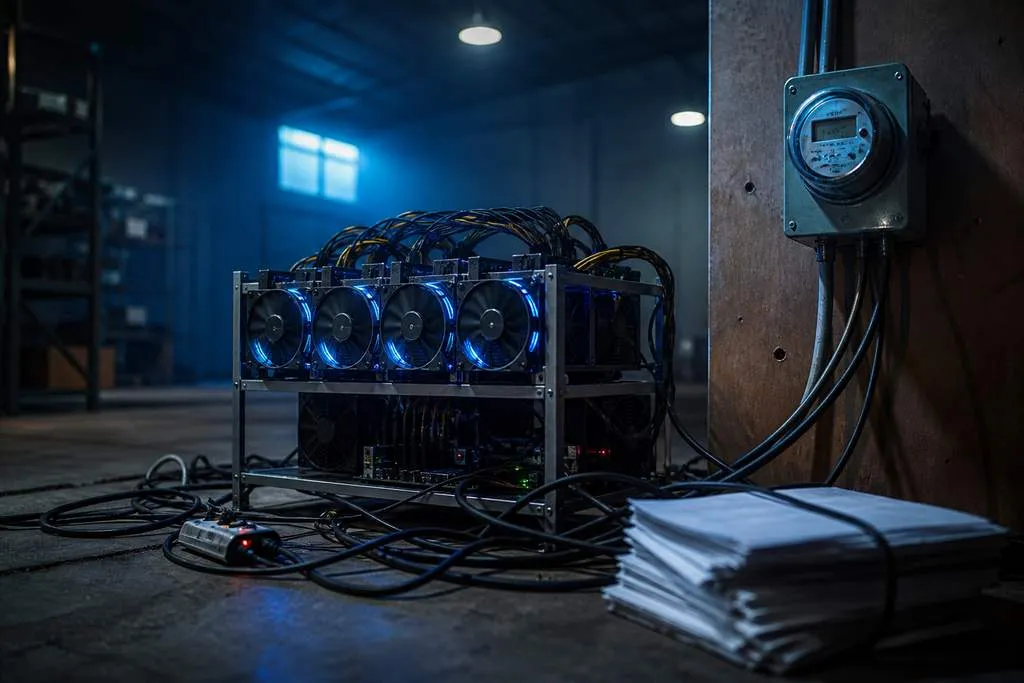
Bitcoin mining is a paid competition to win the right to add the next block of transactions to the chain. Miners gather pending transactions, build a candidate block, and run specialized machines that perform repeated hash calculations until one machine on the network finds a valid result under Bitcoin’s current difficulty target. The winning miner receives the block reward and the transaction fees included in that block. That basic mechanism is why people ask whether mining can be profitable at all: there is real income on one side, but there is also a long list of hard costs on the other.
The practical answer depends less on the abstract idea of “mining” and more on a cost stack. A miner is buying computing hardware, electricity, cooling, space, maintenance time, and usually pool services in exchange for a chance at a stream of bitcoin-denominated rewards. That means the right question is not simply whether mining pays, but which costs dominate, how often they recur, and how quickly equipment loses its edge when newer machines reach the market.
Why does mining bitcoins make money for some operators
Mining makes money only when the value of the bitcoin earned exceeds the total cost of producing it over time. The revenue side has two moving parts. One is the block subsidy, the new bitcoin created with each block. The other is transaction fees paid by users who want their transfers confirmed. Those fees can rise when block space is crowded and fall when demand is lighter, so miner income is not perfectly stable even before power bills are considered.
Participation method also changes the economics. A solo miner keeps the entire reward when it finds a block, but the odds are so low for small operators that income becomes extremely irregular. Most miners join pools. A pool combines hashpower from many participants and distributes rewards according to contributed work, minus a pool fee. Pooling smooths income, but it also introduces another cost line and, in some payout methods, some variance remains if the pool itself has a streak of good or bad luck.
This is why the question “can you make money mining bitcoin” has no universal yes or no answer. A miner with efficient hardware and cheap power may operate above break-even while another miner using older equipment and residential electricity rates loses money on every day it runs.
The hardware costs that shape bitcoin mining margins
Bitcoin can no longer be mined competitively with ordinary computers. The network is dominated by ASICs, machines built for one task: performing SHA-256 hashing as efficiently as possible. That specialization gives them huge performance advantages, but it also means the hardware has little alternative use if mining economics deteriorate.
The purchase price of an ASIC is only the first hardware expense. A working setup often includes power distribution gear, cables rated for continuous load, networking equipment, racks or shelving, and sometimes transformers or upgraded electrical service. If the operation is not hosted in a facility designed for mining, installation costs can become a meaningful part of the budget.
Depreciation matters as much as the sticker price. Mining hardware earns less over time because network difficulty can rise as more hashpower joins the system. Even if a machine keeps working, its share of network rewards may shrink. At the same time, newer ASIC models tend to deliver better efficiency, measured as energy consumed for a given amount of hashpower. That creates a squeeze: older units face both lower competitiveness and lower resale value.
For anyone asking “can i make money mining bitcoin,” this hardware cycle is often the deciding factor. Profitability is not set once at the time of purchase. It changes as the machine ages relative to the rest of the market.
Electricity, cooling, and uptime are the core operating bill
Electricity is usually the largest ongoing cost because ASICs run continuously under heavy load. Mining income depends on the machine being online and hashing, so power draw is not an occasional expense. It is the basic fuel of the business. A small difference in local electricity rate can separate a viable operation from an unworkable one.
Heat follows power use. ASICs convert much of their consumed electricity into heat, and that heat must be managed to keep chips within safe operating ranges. In cooler regions, simple air handling may be enough for part of the year. In hotter climates or denser facilities, operators may need forced ventilation, evaporative cooling, or immersion systems. Each approach adds capital cost, operating cost, and maintenance complexity.
Uptime has a direct financial effect. Every hour a machine is offline is an hour of zero revenue while fixed costs continue. Fans fail, power supplies burn out, dust accumulates, firmware needs updating, and internet outages interrupt work submission to the pool. Large mining farms address this with spare parts, monitoring systems, and technicians. Smaller miners often underestimate how much lost time reduces returns.
This is also where the question “can you make money bitcoin mining” becomes very local. A machine in a warehouse with low-cost power and stable cooling behaves very differently from the same machine in a garage with expensive electricity and poor airflow.
Pool fees, hosting charges, and transaction fee dynamics
Many miners pay for more than electricity. If the equipment is placed with a hosting provider, the operator may pay a monthly hosting rate that bundles power, rack space, internet connectivity, security, and basic maintenance. Hosted mining can solve noise, heat, and electrical capacity problems, but the convenience has a price. A hosting contract may also include minimum terms, curtailment rules during grid stress, or repair charges that cut into margins.
Pool fees are smaller than power bills but still matter because they apply continuously to earned rewards. Different pools also use different payout systems. Some methods shift more variance to the miner, while others smooth payouts in exchange for a different fee structure. The headline fee alone does not tell the full story if stale shares, payout thresholds, or withdrawal conditions reduce realized income.
Transaction fees add another layer. Miners do not control fee demand directly. When demand for block space rises, fees can make a larger contribution to miner revenue. When demand falls, subsidy dominates. Because fee income is variable, a miner relying on occasional high-fee periods to offset weak base economics is taking a real risk.
How network difficulty and halvings change the break-even line
Bitcoin adjusts mining difficulty so blocks continue to arrive on a regular schedule despite changes in total network hashpower. If many miners add machines, the network becomes harder to mine, and each machine earns a smaller share unless it is offset by better efficiency or a rising bitcoin price. That means profitability can deteriorate even when a miner’s own setup does not change at all.
The halving mechanism tightens economics further by cutting the block subsidy on a scheduled basis. When that happens, miners depend more heavily on efficient operations, fee income, and market conditions. The weakest operators tend to be those with high electricity costs, older hardware, or debt taken on during better conditions.
This is the structural reason some miners survive downturns while others shut off. The strongest setups are built around low operating costs first, not around optimistic revenue assumptions.
A realistic takeaway on whether mining bitcoins makes money
Mining can produce profit, but only when the operator treats it as an industrial cost problem rather than a simple way to collect bitcoin. The first filter is power cost. The second is hardware efficiency over its useful life. After that come cooling, downtime, pool fees, hosting terms, and repair exposure. If those pieces are weak, the block reward does not rescue the model.
A concrete way to judge the idea is to map every recurring expense before any machine is purchased: electricity rate, estimated continuous power draw, cooling method, pool fee, likely maintenance, and the period over which the hardware could lose competitiveness. If those costs are uncertain, the project is riskier than it appears. If they are well controlled, then yes, mining may make money under the right conditions. The deciding edge is rarely luck. It is disciplined cost structure.