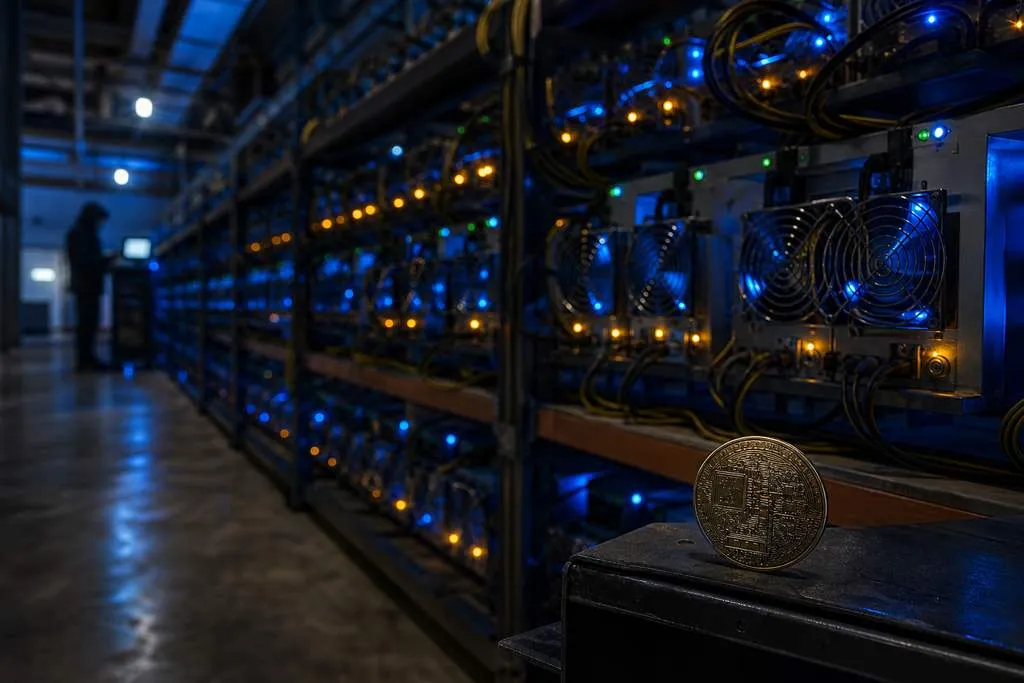
Many people picture Bitcoin creation as if coins are printed by a company, released by a founder, or discovered like gold sitting in the ground. None of those pictures is quite right. Bitcoin has no issuer deciding who gets new units each day. New coins appear only because the network follows a public set of rules that rewards certain participants for doing a specific job: gathering transactions into valid blocks and proving, through computation, that they earned the right to add that block.
The simplest useful analogy is a ledger that updates in rounds. In each round, many computers compete to seal the next page of that ledger. The page must include valid transactions, follow strict formatting rules, and contain a proof that was expensive to produce but easy for everyone else to verify. When a page is accepted by the network, the rules allow a special transaction inside that page to create new bitcoin. That is the mechanism behind issuance. To understand how bitcoins are generated, it helps to separate the coin creation rule from the competition that decides who may use it.
How bitcoins are generated through block rewards
At the protocol level, new bitcoin is created in a transaction often called the coinbase transaction. This is not the retail company with a similar name; in Bitcoin, coinbase means the first transaction in a block, written by the miner who assembled that block. Unlike ordinary transactions, it does not spend earlier coins. Instead, it creates new coins up to the amount allowed by the rules, plus any transaction fees from the transactions included in that block.
That detail corrects a common misunderstanding. Mining does not mean miners dig up pre-existing coins from a hidden reserve. The coins are created at the moment a valid block is accepted. The network treats that creation as valid only because every node can check that the amount matches the schedule built into the software. If a miner tried to award itself too much, other nodes would reject the block.
So when people ask how are new bitcoins generated, the accurate short answer is this: they are generated inside valid blocks as part of the block reward, according to consensus rules enforced by thousands of independently run nodes.
Why mining is a competition, not a printing press
The next myth is that miners can simply choose to mint coins whenever they want. They cannot. To create the reward transaction, a miner first has to win the block race. That race is based on proof of work. A miner collects pending transactions, builds a candidate block, and repeatedly changes a small piece of data until the block’s hash falls below the current target set by the network.
A useful everyday comparison is a lottery where effort buys tickets, but the winning ticket must also be attached to a valid page of accounting. The miner cannot submit nonsense and still claim the reward. The transactions must be legitimate, signatures must verify, and the block must reference the accepted chain history.
This is where the energy and hardware fit into the picture. They are not powering the creation of coins by themselves. They are part of the contest that makes it costly to rewrite history or fake a winning block. The network is paying for security and ordering, with new issuance as part of that payment.
The fixed schedule behind how new bitcoins are generated
Another mistake is to imagine that Bitcoin production rises when demand rises or falls when a committee decides to tighten supply. Bitcoin does not work that way. The issuance schedule is rule-based. The subsidy attached to each block declines over time according to the protocol. That means how new bitcoins are generated is predictable in structure even though the identity of the winning miner is not.
The network also adjusts mining difficulty so that blocks do not arrive much faster just because more machines join the race. If additional miners appear, finding a valid block becomes harder over time. If miners leave, it becomes easier after adjustment. This balance is essential. It means more mining power does not let the system spray out coins arbitrarily; it mainly changes how difficult it is to win the next reward.
Put plainly, supply is governed by software rules and network consensus, not by the size of a mining company, the mood of a government, or a sudden spike in market interest.
What miners actually do before a bitcoin is created
People often compress mining into one vague idea, but the work has distinct steps. First, miners select transactions from the pool of pending transfers. They usually prefer transactions that offer higher fees, though they also consider transaction size and policy rules. Next, they verify those transactions and assemble them into a block, including a reference to the previous accepted block.
They then create the coinbase transaction that pays the allowed reward to an address they control. After that, they build a compact summary of all transactions in the block and begin hashing the block header over and over with different values. This trial-and-error process is what proof of work looks like in practice.
If a miner finds a valid result, it broadcasts the block. Other nodes check the proof, verify the transactions, confirm the reward amount is allowed, and only then accept the new block as part of the chain. The new bitcoin exists for network purposes at that point, though miners typically wait for additional blocks to be added after it before treating the reward as safely spendable.
Why not every block reward feels like “new money”
It is tempting to think each block reward is pure issuance, but a block reward has two parts: the newly created subsidy and the transaction fees already paid by users. Fees are not newly created coins. They are existing bitcoin moved from spenders to the miner. Only the subsidy portion expands supply.
This distinction matters because it explains how Bitcoin can keep functioning after the subsidy keeps shrinking. The security budget can come from a mix of issuance and fees. In earlier periods, the subsidy is a larger share of miner revenue. Over time, fees matter more. That transition is built into the design and is one reason serious discussions of mining focus on both issuance and fee markets rather than on “coin creation” alone.
It also clears up another myth: miners are not paid only in newly made bitcoin. Their income can include both new units and redistributed existing units from transaction fees.
Common myths about how bitcoins are generated
One persistent myth says a powerful miner can create extra bitcoin by changing its own software. That fails because the miner does not define the rules by itself. Full nodes run by exchanges, businesses, wallet providers, and individual users validate blocks independently. A block that breaks supply rules is ignored.
Another myth says bitcoin is generated by solving useful math problems. The work is real, but it is not performing scientific research or decrypting hidden messages. The computation is deliberately hard to produce and simple to verify. Its purpose is to secure consensus over transaction history.
A third myth is that all bitcoin was generated at the beginning and merely released later. In fact, coins enter circulation block by block under the issuance schedule. Early participants did not receive access to a warehouse of pre-mined units controlled by a central distributor. The rules created a path for issuance over time through mining.
A final confusion is between ownership and creation. Buying bitcoin on an exchange does not generate any new coins. It transfers existing coins from one holder to another. New issuance happens only at the protocol level when a valid block includes the allowed subsidy.
The practical takeaway: follow the block, not the story
The clearest way to judge claims about Bitcoin issuance is to ask where the coin came from. If it came from a normal transaction, it was transferred. If it came from the first transaction in a valid block, within the allowed reward, it was newly created by the protocol. That single check cuts through most bad explanations.
For ordinary readers, the durable mental model is simple: miners are competing accountants who must prove they spent real computational effort to earn the right to write the next page of a public ledger. The network pays the winner with a block reward that may include newly created bitcoin and user-paid fees. If that model is kept in mind, most myths about how bitcoins are generated fall away on their own.