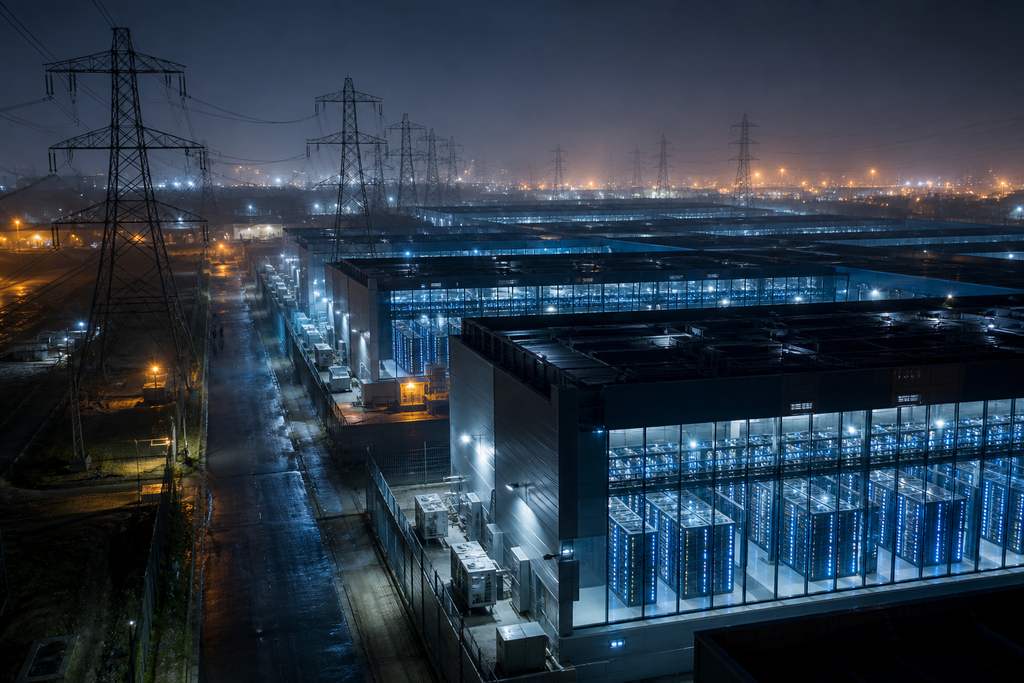
Bitcoin energy debates often get buried under slogans about annual electricity use, but the useful question is simpler: what mechanism turns a digital asset into sustained power demand? Reading de vries 2026 bitcoin’s growing energy problem joule through that lens helps. The value of the article is not a single headline number. It is the chain of cause and effect linking market incentives, mining hardware, and power consumption.
A practical way to understand that chain is to treat bitcoin mining like an automated lottery run by warehouses full of specialized computers. Each machine buys lottery tickets by doing repeated calculations. The network raises the difficulty so tickets become harder to produce when more machines join. That means higher coin prices do not just reward existing miners; they also attract more hardware, which pushes the whole system toward higher aggregate electricity use unless some counterforce limits expansion.
How de vries 2026 bitcoin’s growing energy problem joule breaks the mechanism into steps
The easiest walkthrough starts with the block reward. Miners compete to add the next block and receive newly issued bitcoin plus transaction fees. Because the winner is chosen through proof-of-work, every participant keeps hashing at high speed even though only one miner or pool wins each round. The work of the losers is not stored as a useful output elsewhere; its role is to make the network costly to attack.
Step two is the adjustment rule. Bitcoin does not let blocks arrive much faster just because more miners arrive. Instead, the protocol periodically increases mining difficulty so the average block interval stays near its target. That single design choice is what turns competition into an energy race. More participants do not produce proportionally more transactions. They mostly produce more security expenditure in the form of hardware and electricity.
Step three is miner economics. A miner estimates expected revenue per unit of hash rate, then compares it with electricity costs, machine efficiency, cooling, debt, and hosting fees. If revenue exceeds cost, more machines tend to come online. If revenue falls below cost, older and less efficient units shut down first. This explains why energy demand moves with profitability rather than with ordinary measures of network usage, such as how many people send coins on a given day.
What de vries bitcoin’s growing energy problem joule 2026 says about demand growth
When readers search for de vries bitcoin’s growing energy problem joule 2026, they are usually looking for a claim about whether bitcoin can keep absorbing power as long as prices support it. The answer lies in how mining scales. A higher bitcoin price can justify operating machines that were previously idle, extending the life of less efficient hardware and encouraging new investment in data centers. That does not mean energy use rises in a straight line forever, but it does mean there is no automatic cap from transaction volume.
The hardware side matters because bitcoin miners use application-specific integrated circuits, or ASICs. These chips are designed for one job: hashing. Efficiency improvements reduce electricity per unit of hash rate, but the network difficulty mechanism changes the effect. Better chips lower cost per ticket in the lottery, which can invite even more tickets to be purchased. In practice, efficiency gains can soften growth in electricity use, yet they do not guarantee an absolute reduction if total hash rate expands faster.
This is where a plain-language analogy helps. Imagine a gold rush where better shovels appear each year. If the prize remains valuable, miners may not spend less effort overall; they may simply dig more ground because each shovel stroke became cheaper. The Joule framing is useful because it keeps attention on that rebound effect instead of assuming technical improvement alone solves the underlying incentive.
Reading the mining process without getting lost in jargon
For a nontechnical reader, the process can be followed in four plain steps. First, mining companies acquire ASICs and place them where electricity and cooling are workable. Second, they point those machines at a pool, which coordinates many miners and smooths payouts. Third, the machines run continuously, converting electricity into hashes. Fourth, if enough miners globally do the same, network difficulty rises, preserving block timing while raising the total amount of work being done.
The key point is that each step reinforces the next. Pools reduce payout volatility, making industrial mining easier to finance. Financing supports bigger deployments. Bigger deployments intensify competition. Difficulty absorbs that competition. Energy demand therefore emerges from the structure of the system, not from waste by accident or from a temporary software bug.
That is also why discussions framed only around “how many homes could this power” often miss the core issue. The real analytical task is to map who can enter, what hardware they use, what power price they can tolerate, and how protocol rules convert those business decisions into a global baseline of electricity consumption.
Where estimates can mislead and how to read them carefully
Energy estimates for bitcoin are usually built from indirect evidence, because the network does not publish a meter reading. Analysts infer likely consumption from total hash rate, machine efficiency bands, miner profitability, and observed hardware generations. That method is reasonable, but each input carries uncertainty. Some miners run the newest chips, others keep older fleets online in places with unusually cheap power. Some sites curtail during grid stress; others run nearly nonstop.
A careful reading of de vries 2026 joule bitcoin’s growing energy problem should therefore focus less on any exact figure and more on the directional logic. If hash rate rises while the active machine mix does not become efficient enough to offset it, electricity demand tends to rise. If prices fall hard enough, the least efficient miners exit and demand can fall. If a region offers stranded or curtailed power, miners may use energy that would otherwise go unused for part of the time, but that does not erase the broader incentive to keep expanding when margins are attractive.
Another common mistake is to blend electricity use with emissions as if they are the same variable. They are linked but not identical. Electricity use describes the amount of power consumed. Emissions depend on the fuel and grid mix behind that power, plus when and where miners operate. An article in Joule can discuss both, but the mechanism for each should be kept separate when evaluating claims.
What the Joule argument means for policy, grids, and investors
If the mechanism is understood, the policy implications become clearer. Grid operators care about whether mining load is interruptible, whether it competes with other demand, and whether it concentrates in already stressed regions. Local communities care about noise, heat, and industrial buildout. Investors care about machine depreciation, power contracts, and the risk that a revenue squeeze makes today’s equipment uneconomic.
For policymakers, the step-by-step view suggests that broad claims are less useful than targeted rules. Disclosure of power sources, site-level demand, curtailment behavior, and ownership structure can reveal more than debates over ideology. For markets, the same view explains why mining stocks can behave like a leveraged bet on both bitcoin price and power access. For critics and defenders alike, it clarifies that the argument is about incentives embedded in proof-of-work competition, not just about whether one likes bitcoin.
This practical reading also answers why the phrase de vries bitcoin’s growing energy problem joule 2026 keeps circulating. Readers want a compact explanation for why energy demand can remain structurally high even when the network itself is stable. The answer is that protocol stability at the transaction layer can coexist with fierce instability in the competition to secure those transactions.
A concrete way to evaluate future claims about bitcoin energy
When a new headline appears, use a short checklist. Start with hash rate: did it rise, fall, or plateau? Then look at profitability drivers: coin price, fees, and major cost shifts. Next ask what hardware likely entered or exited the fleet. Finally separate electricity from emissions by asking where the power came from and whether mining load was flexible. That sequence gives a grounded reading of almost any new estimate without needing access to hidden company data.
The practical takeaway is simple. Do not judge bitcoin’s energy problem by transaction counts or by a single annual number alone. Judge it by the feedback loop among price, miner entry, hardware efficiency, and difficulty adjustment. If that loop is favorable to expansion, power demand can grow even when the user experience of the network looks unchanged. That is the clearest lesson to carry forward from de vries 2026 bitcoin’s growing energy problem joule.