
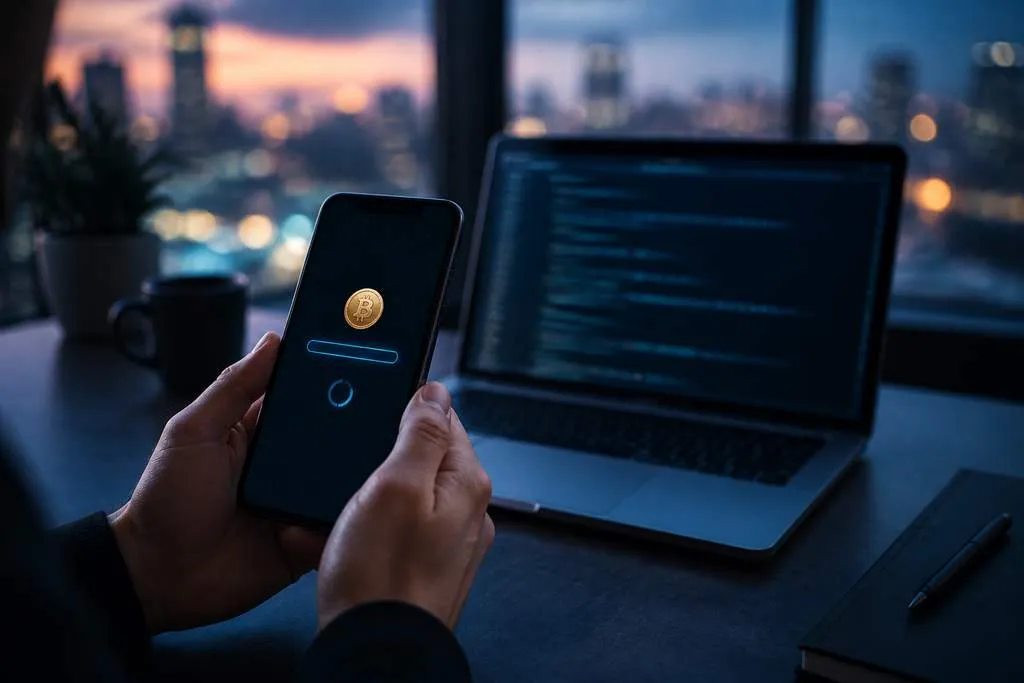
People often talk about Bitcoin transfers as if they have one fixed travel time, like an email or a bank wire. That is the first thing to correct. A Bitcoin payment moves through stages: it is created by a wallet, broadcast to the network, stored in a waiting area called the mempool, included by a miner in a block, and then buried under later blocks for stronger finality. Each stage has its own delays, so the answer depends on what kind of “done” a person means.
The second common mistake is to think the network itself sees all transactions equally. It does not. Miners usually choose transactions that pay higher fees first, because block space is limited. A simple way to picture it is a stack of shipping labels competing for room in the next truck. The truck leaves on a schedule the sender cannot control, and the labels offering a bigger tip are usually loaded first. That is why two payments sent at the same moment can finish at very different times.
How long do bitcoin transactions take from broadcast to confirmation
When people ask how long does a bitcoin transaction take, they are usually asking about the first confirmation. After a wallet sends the transaction, nearby nodes check basic validity and relay it across the network. That broadcast is often fast. The slower part is waiting for a miner to place it into a block.
Bitcoin aims for blocks to appear about every ten minutes on average, but “average” is doing a lot of work here. A block can arrive much sooner or much later. That means a transaction with a competitive fee might confirm in the next block, or it might wait through several block intervals even when nothing is wrong. A low-fee transaction can wait far longer if the mempool is crowded.
So if someone asks how long does bitcoin transaction take, the practical answer is: the network may hear about it quickly, but the first meaningful settlement point is the first block confirmation, and that timing is variable rather than fixed.
Why one confirmation is not the same as final settlement
Another myth is that a transaction is either pending or complete, with no middle ground. Bitcoin is more layered than that. Before confirmation, a merchant or exchange sees an unconfirmed transaction. After one confirmation, the payment is included in the blockchain. After more confirmations, reversing that payment becomes progressively harder because an attacker would need to replace more chain history.
That is why services set different confirmation requirements. A café accepting a small in-person payment may treat a low-risk payment as good enough earlier than an exchange crediting a large deposit. The network does not declare one universal finish line for every use case. Businesses choose their own risk threshold.
This is where confusion starts. One person says Bitcoin took ten minutes because their wallet showed one confirmation. Another says it took an hour because the service they used waited for several confirmations before crediting funds. Both reports can be true, because they are measuring different stages of the same process.
What actually decides how long do bitcoin transactions take
The biggest factor is the fee rate attached to the transaction, usually measured relative to the transaction’s data size. Bitcoin fees do not buy speed in a direct, guaranteed way; they improve queue position. If many people are competing for limited block space, higher-fee transactions are more attractive to miners.
Transaction shape also matters. A transaction that uses many small inputs takes more space than one built from fewer inputs, so the fee needed to stay competitive can be higher even if the amount sent is small. This surprises users who assume a tiny payment should always move cheaply and quickly.
Wallet behavior matters too. Some wallets estimate the fee based on current mempool conditions and a target such as “confirm soon” or “economy.” A weak estimate can leave a transaction underpriced for current demand. The result is not network failure. It is simply a low-priority item waiting for enough room.
There is also randomness. Even a well-priced transaction can miss the next block because miners found another block before yours propagated widely, or because the next few blocks were filled with even higher-fee entries. Bitcoin is a competitive auction for scarce space, not a timed conveyor belt.
Mempool traffic creates the delays people blame on Bitcoin
A useful analogy is an airport security line that feeds into a gate with limited seats. The mempool is the line. A new transaction joins with a fee ticket attached. When a miner builds a block, that block has limited room, so some transactions board and others remain waiting. If many passengers arrive at once, the line grows and the cheapest tickets stay behind.
This explains why screenshots of “stuck” transactions can be misleading. The coins are not frozen inside the blockchain. Usually the transaction is waiting outside the chain for inclusion. Different blockchain explorers may display slightly different mempool views, but the core idea is the same: the delay often comes from queue congestion, not from a transfer already inside a block moving slowly through the system.
Some wallets support fee-bumping tools such as Replace-By-Fee, which lets the sender resend a version with a higher fee if the original remains unconfirmed. In some cases a recipient can use child-pays-for-parent logic, where a later transaction offers enough fees to motivate miners to include both together. These tools do not break Bitcoin’s rules. They work within the normal fee market to improve queue position.
Why exchange deposits and wallet balances show different timing
Many complaints about timing are really complaints about service policy. A self-custody wallet may show an incoming payment as soon as it detects the unconfirmed transaction, then mark confirmations as they arrive. An exchange usually waits longer before making funds spendable because it is managing fraud risk and operational risk on behalf of many users.
That means a person can send bitcoin, see it on a blockchain explorer, see one confirmation in the sending wallet, and still not have a credited balance at the destination platform. The blockchain and the platform are separate layers. The blockchain confirms the transaction; the platform decides when to trust it enough to update the account.
This difference is why broad statements such as “Bitcoin takes an hour” or “Bitcoin is instant” both miss the mechanism. The chain may confirm a payment in one block, while the receiving business deliberately waits for more. The user experiences the total delay, but part of that delay comes from business rules rather than the protocol itself.
Zero-confirmation payments and the myth of instant Bitcoin
Some apps display incoming payments almost immediately after broadcast. That leads people to claim Bitcoin is instant. What they are really seeing is a zero-confirmation transaction: visible on the network, but not yet mined into a block. For low-value situations, some merchants may accept that risk. For larger payments, most serious counterparties prefer at least one confirmation, and often more.
The risk before confirmation is simple to explain. Until a miner commits the transaction into a block, there is still uncertainty about which valid transaction version the network will ultimately include, especially if the sender controls the wallet and fee settings. Once confirmed, the payment has crossed a more meaningful threshold. Additional confirmations strengthen it further.
So the myth to bust is not that instant displays are fake. They are real signals of network propagation. The mistake is treating fast visibility as the same thing as settled finality.
The practical takeaway when timing matters
If timing matters, the useful habit is to think in checkpoints. First, ask whether the transaction has been broadcast successfully. Second, check whether the fee rate is competitive for current mempool conditions. Third, separate blockchain confirmation time from the receiving service’s credit policy. Those three checks explain most delays without guesswork.
For a payment that must arrive promptly, use a wallet that shows fee options clearly and supports fee bumping if needed. For a deposit to an exchange, assume the service may wait beyond the first confirmation. For a small face-to-face payment, understand that seeing it instantly is not the same as having irreversible settlement. The concrete rule is simple: when someone asks how long do bitcoin transactions take, answer by asking which stage they mean, because that stage is what determines the real wait.