Bitcoin mining is often described as a race to record transactions. A better practical picture is a global accounting contest: specialized machines repeatedly guess a valid block hash, and the winner earns the right to add the next block and collect the block reward plus transaction fees. That process keeps the network hard to rewrite, but it also means mining is a business shaped by power prices, machine efficiency, heat, noise, and regulation.
For people in the UAE, the legal question matters before the technical one. The short answer is that personal possession and operation of mining hardware is not broadly banned by a single federal rule that says “mining is illegal.” The harder part is that legality depends on where the activity takes place, what electricity source is used, whether a host facility or free-zone operator allows it, and whether the setup creates licensing, customs, zoning, or utility issues. Comparing the available paths helps separate what is possible from what is practical.
Is bitcoin mining legal in UAE in practical terms
The most accurate way to frame is bitcoin mining legal in uae is to treat it as a compliance question rather than a simple yes-or-no. Mining itself is a technical activity: running hardware that performs proof-of-work calculations. UAE law and regulation tend to focus on business activity, energy use, imported equipment, premises rules, and financial services boundaries rather than on a single mining-specific prohibition for individuals.
That means an at-home miner, a warehouse operator, and a company selling hosted mining contracts do not face the same regulatory picture. A home setup may be affected by building rules, landlord restrictions, utility terms, and noise complaints. A commercial operation may need trade licensing, compliant premises, customs treatment for imported ASICs, and a clear relationship with the local electricity provider. If a firm pools customer funds or markets profit expectations, separate financial and consumer protection issues can appear.
In other words, the activity can be lawful while a specific implementation is not. That distinction matters more in the UAE than broad internet claims about “crypto-friendly” jurisdictions.
How Bitcoin mining works and why the economics are unforgiving
Mining uses ASICs, purpose-built chips that do one task extremely well: SHA-256 hashing. These machines compete globally, so a miner in the UAE is not competing only with local operators but with industrial farms worldwide. When total network hashrate rises, the protocol adjusts difficulty, which means older machines become less competitive unless power is cheap and uptime is high.
The main cost driver is electricity, followed by cooling, machine depreciation, and maintenance. The UAE adds a climate-specific challenge: heat. ASICs turn most consumed power into heat, so a miner must pay for ventilation or air conditioning, and poor cooling shortens hardware life. Dust is also relevant in many locations; clogged filters and fans reduce efficiency and raise failure risk.
This is why articles promising easy passive income from a spare room are misleading. Mining is closer to running loud, heat-intensive industrial equipment than to staking tokens from a phone app. Anyone comparing options in the UAE should start with energy, cooling, and premises constraints, not with reward projections.
Home mining in the UAE: the simplest option with the narrowest margin
The most accessible option is to buy one or more ASICs and run them at home or in a small private space. Legally, this can be the least complicated because there may be no customer funds, no public offering, and no commercial hosting service involved. Operationally, it is often the worst fit.
ASICs are noisy enough to disrupt a household, and their constant heat output can overwhelm ordinary residential cooling. Even if a resident is allowed to use high-power equipment, building management or a landlord may object to noise, wiring load, or ventilation modifications. Home tariffs and service conditions are another key factor. A setup that appears viable on paper can fail once power quality, breaker limits, and cooling costs are counted together.
There is also a tax and customs angle at the import stage. Hardware may clear normally as computing or electronic equipment, but buyers still need to account for shipping, duties where applicable, and warranty limitations. Many ASIC warranties are short and can be difficult to enforce across borders. For UAE residents, home mining is mainly an experiment or hobby route unless the property and power arrangement are unusually favorable.
Hosted mining and data-center style setups offer control at a price
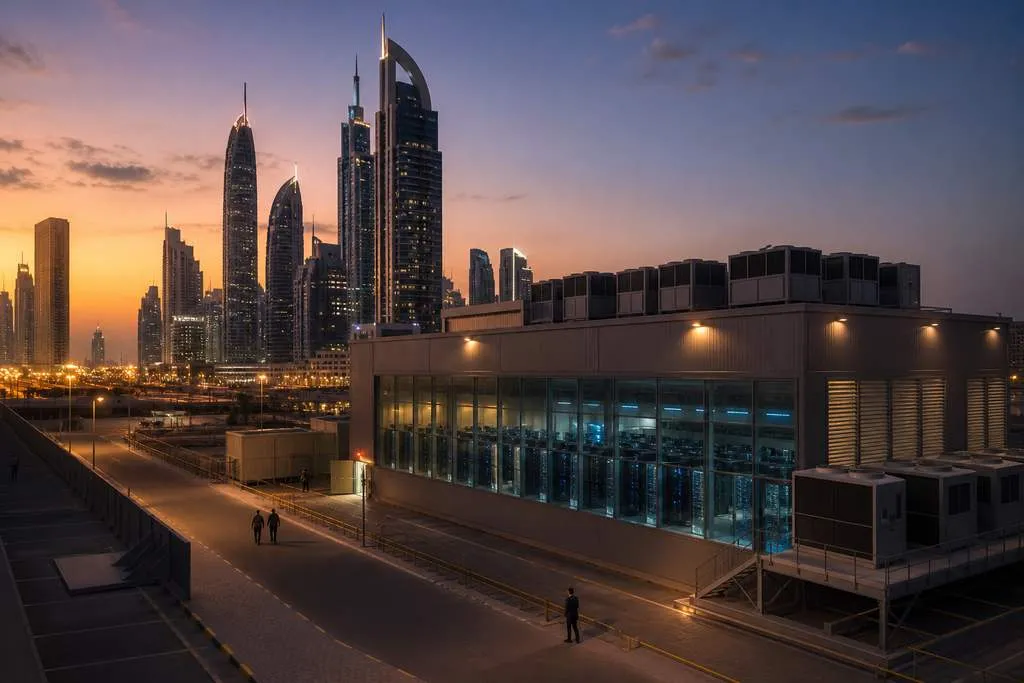
A second option is hosted mining: owning the machines but placing them in a facility that supplies rack space, power, cooling, and internet. This model solves the household noise and heat problem and can provide better uptime if the host is competent. In the UAE context, hosted arrangements may exist through specialist operators, industrial premises, or broader data-center style environments, though not every facility will accept ASIC loads.
The legal advantage is clearer separation between the equipment owner and the physical site operator. The tradeoff is contractual dependence. A miner needs to know who is responsible for customs handling, installation, machine replacement, maintenance, metering, power curtailment, and shutdown rights if utility conditions change. Hosting agreements should also specify what happens if the facility loses access to suitable electricity or if local authorities question the use of premises for mining.
Hosted mining usually makes more sense than home mining in hot climates because cooling can be engineered properly. Still, hosting fees can erase any efficiency gains if pricing is not transparent. The attractive version of hosting is one where the operator has a lawful site, robust electrical design, and a contract that treats power usage and downtime with precision.
Industrial mining in free zones or mainland operations
The third path is a larger commercial operation on the mainland or in a free zone. This is the option most likely to require formal business setup, trade licensing, leased industrial space, and direct utility planning. It can also be the only format where economies of scale start to matter, because bulk power arrangements, airflow design, and maintenance procedures improve as the site grows.
In the UAE, the key question is not simply whether a free zone is “crypto friendly.” Many free zones are friendly to digital asset businesses in a licensing sense, but that does not automatically mean they are suitable for high-load proof-of-work mining. Mining needs physical infrastructure: transformers, ventilation, acoustic management, fire safety systems, and often utility approval for sustained heavy consumption.
Mainland industrial sites may provide more realistic physical conditions than office-oriented zones, but they also require careful review of municipal and utility requirements. A business that describes itself as a technology company may still need explicit confirmation that mining equipment can be installed and run on site. For serious operators, local legal counsel and utility-side due diligence are not optional.
Cloud mining contracts are the easiest to buy and the hardest to verify
A fourth option often marketed to UAE users is cloud mining. In this model, the buyer does not own or physically control hardware in the country; instead, the buyer purchases a contract tied to remote hashpower. From a convenience standpoint, this removes local power, cooling, and premises issues. From a risk standpoint, it introduces a different problem: verification.
Many cloud mining offers are opaque about where machines are located, how maintenance fees are charged, and whether the operator actually controls the advertised capacity. That creates legal and practical uncertainty. Even if the contract itself is not prohibited, collecting on it can be difficult if the operator is overseas, lightly regulated, or intentionally vague. The easier the product looks, the more important contract scrutiny becomes.
Compared with owning hardware in the UAE, cloud mining gives up operational control. For that reason, it should not be grouped with local mining in any serious comparison. It is closer to buying a remote service claim than to operating a mining business.
A workable UAE approach starts with compliance and electricity
The best concrete takeaway is to rank options in this order: first verify premises and power legality, then compare operating models. For most individuals in the UAE, home mining is legally possible in a narrow sense but usually constrained by heat, noise, and residential power realities. Hosted mining can be more practical if the facility is transparent and properly contracted. Large commercial mining is viable only when licensing, industrial space, and utility arrangements are aligned from the start. Cloud mining is the least burdensome locally but carries the highest verification risk.
A sensible first step is simple: before buying any ASIC, confirm whether the intended site allows the electrical load and continuous operation, then ask a UAE-qualified lawyer or business setup adviser how the activity should be classified at that scale. If those answers are unclear, the machine purchase is premature. In mining, bad assumptions about power and compliance usually cost more than bad assumptions about hardware.