Bitcoin mining is often described as a race to write the next page of a public ledger. That metaphor is useful because it captures the core mechanic: many machines compete to package recent transactions into a block, and only one valid block wins each round. The winner earns newly issued bitcoin plus transaction fees included in that block. What gets lost in the simple version is what the race requires under the hood. Mining is not just “running software.” It is continuous computation, hardware deployment, electrical consumption, network coordination, and maintenance.
That is why the question is it free to mine bitcoin has a short answer and a more useful answer. The short answer is no. The useful answer is that some people can begin experimenting without paying upfront for specialized machines, but the mining process itself always consumes resources somewhere. Even when a website or app presents “free mining,” the costs are either shifted to another party, hidden inside fees and low payouts, or replaced by a simulation that does not contribute meaningful Bitcoin hashpower.
Why is it free to mine bitcoin has a misleading ring
Bitcoin uses proof of work. Miners repeatedly run the SHA-256 hashing function on block header data, changing a small field called the nonce and sometimes other values, trying to produce a hash below the current network target. The target adjusts so that blocks are found at a steady average rhythm. This means mining is intentionally expensive in computational terms. The network’s security comes from the fact that producing valid blocks requires real-world energy and hardware, while verifying a block is easy for everyone else.
Under the hood, there is no “free mode” in the protocol. Every hash operation uses electricity, and every serious mining setup requires chips designed for one job: perform SHA-256 hashes as efficiently as possible. These ASIC miners displaced CPUs and GPUs for Bitcoin years ago because general-purpose hardware cannot compete on efficiency. A laptop can still calculate hashes, but at such a tiny share of total network power that the chance of earning a block reward is effectively negligible.
So when people ask can I mine bitcoin for free, they are usually mixing three different ideas: learning how mining works, joining a service that claims to mine on their behalf, or trying to earn small amounts of bitcoin through promotions that are unrelated to actual proof-of-work mining. Only the first is straightforward, and it teaches the process rather than generating meaningful output.
What actually happens inside a Bitcoin mining machine
A miner does not examine the whole blockchain every second. It receives candidate transactions from the network, checks that they are valid, and assembles them into a candidate block. It also inserts a special transaction called the coinbase transaction, which is where the block subsidy and fees are assigned. Then the machine builds the Merkle root for the block’s transactions, combines that with other header fields, and starts hashing over and over.
The vast majority of those attempts fail, by design. A valid result is rare enough that miners perform huge numbers of hash calculations continuously. That is the work being “proved.” If one miner finds a valid block, the block is broadcast to the network. Other nodes verify the proof of work and the included transactions. Then the race restarts on top of the new chain tip.
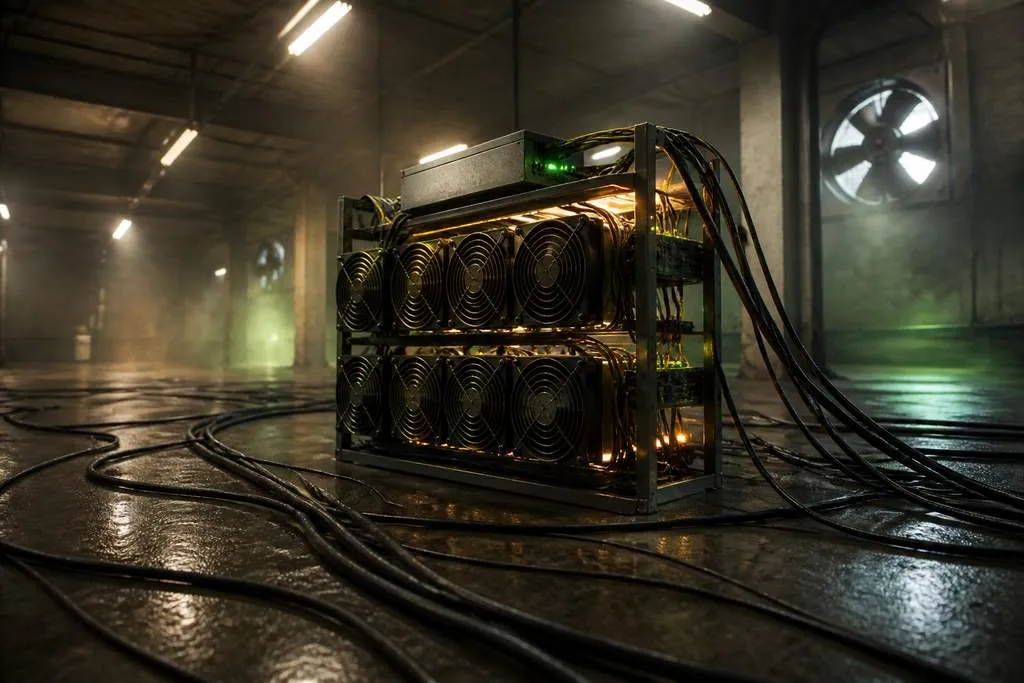
This explains why home miners focus so much on watts, cooling, uptime, and firmware. Mining revenue is uncertain from block to block, but power draw is relentless. Heat is not a side effect that can be ignored; it is the physical form of the energy being spent on hashing. Fans, noise control, ventilation, dust management, and failed power supplies are part of the under-the-hood reality.
Can I mine bitcoin for free with a phone, laptop, or browser
In a literal sense, a device already sitting on a desk can run mining software. That leads many beginners to ask is it possible to mine bitcoin for free. If “free” means “without buying an ASIC first,” then a phone or laptop can be used to test software or understand block templates, pools, and wallets. If “free” means “without incurring cost,” the answer is still no, because the device uses electricity, adds wear, and contributes hashpower so small that the expected reward is close to zero.
Browser mining adds another layer of confusion. Websites once promoted in-browser hashing, but that model never made sense for Bitcoin at meaningful scale. Browser-based scripts are inefficient, throttled by the environment they run in, and unsuitable for competing with specialized equipment. In many cases, what is marketed as browser mining is actually a reward platform, a faucet, or a cloud contract unrelated to direct block production.
Phones are even worse candidates for real Bitcoin mining. Mobile chips are built for battery life and general computing tasks, not industrial hashing. Sustained heavy load creates heat and battery stress while delivering almost no useful share of network work. For learning, a phone can monitor a miner or wallet. For mining Bitcoin itself, it is not a practical tool.
Mining pools changed how people participate
Because finding a block alone is statistically rare unless hashpower is very large, most miners join pools. A pool operator distributes work to many participants and tracks how much each contributes through shares, which are proofs that show a miner is doing useful work even if those shares are not difficult enough to become a full Bitcoin block. When the pool finds a real block, rewards are divided according to the pool’s payout method and fee structure.
Pools make participation smoother, but they do not make mining free. They simply turn a lumpy, low-probability process into smaller, more regular payouts. The hardware still has to run. The pool still charges a fee. The operator still needs reliable infrastructure. If someone asks is there a way to mine bitcoin for free by joining a pool, the honest answer is that pools reduce variance, not costs.
This is also where many cloud-mining offers enter the picture. Instead of running hardware, a customer pays for a contract tied to someone else’s machines. The appeal is obvious: no noise, no heat, no setup. The problem is that the customer has no direct control over the hardware, the accounting, or the assumptions behind the contract. Some services are simply sales wrappers around expected mining output. Others are opaque enough that a buyer cannot tell whether real machines are involved at all.
Where the real costs appear even before profits are considered
The biggest visible cost is electricity, but it is not the only one. Efficient mining depends on the relationship between machine output and power draw, which is why ASIC generations matter. Older units may still function but can become economically weak if they consume too much power per unit of hashpower compared with newer models. Then come infrastructure costs: power delivery, breakers, cabling, shelving, networking, ventilation, and sometimes transformers or immersion systems in larger setups.
There are also operational costs that beginners often overlook. Internet use is modest, but uptime matters. Dust can clog heatsinks. Heat can shorten component life. Cheap hosting may bring curtailment, outages, or poor maintenance. Firmware choice affects stability and tuning. Even at small scale, someone has to monitor failed boards, fan issues, and rejected shares.
None of this requires quoting revenue figures to make the point. Mining is an industrial process attached to a digital asset. The protocol sends rewards to valid blocks, but reaching that point requires spending physical resources in the real world. That is the reason “free Bitcoin mining” almost always turns out to mean something other than participating directly in proof of work.
A practical way to approach Bitcoin mining without chasing free myths
The sensible starting point is to separate education from production. For education, run a Bitcoin node, study how blocks are built, inspect a block explorer, and if desired connect to mining software in a test environment or with a tiny setup purely to observe how shares and pool connections work. That can answer the curiosity behind can I mine bitcoin for free better than any ad can, because it shows the mechanism without pretending the mechanism has no cost.
For production, treat mining as hardware operations first and finance second. Check power availability, cooling options, noise tolerance, and the reputation of any pool or host before thinking about output. Avoid services that promise effortless free mining from a phone, browser, or vague cloud dashboard. If the provider cannot clearly explain where the hashpower sits, how rewards are measured, what fees apply, and how withdrawals work, the offer is not transparent enough.
The concrete takeaway is simple: use “free” only for learning tools, not for expectations about real Bitcoin mining. If the goal is to understand the system, there are low-cost ways to observe and experiment. If the goal is to mine actual Bitcoin, assume electricity, hardware, and maintenance are part of the job from the first hash onward.