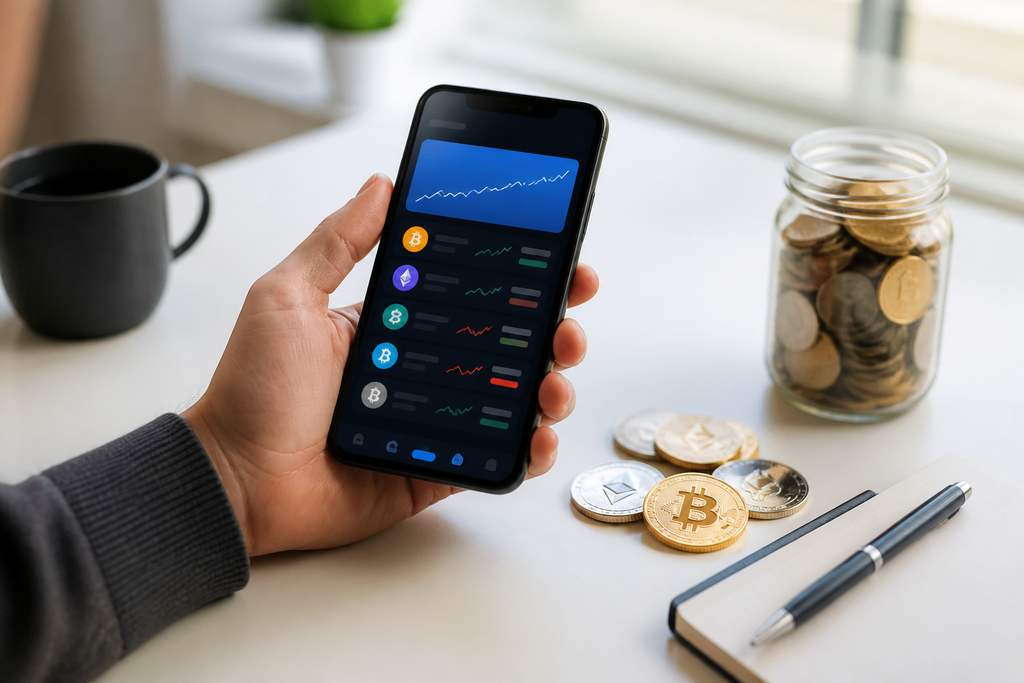
Trading volume — the total value of a coin that changes hands over a given period — is one of the first numbers on any market screen and one of the most misread. A high figure suggests you can enter and exit without moving the price. A thin one warns that your own order may become the market.
There is no single cutoff that works everywhere. Volume that is trivial for Bitcoin would be exceptional for a micro-cap token, and the same asset can look liquid on one exchange and dead on another. The practical answer comes from three comparisons: volume relative to market cap, relative to your position size, and relative to the specific venue where you plan to trade. The sections below compare the main options — venue types, data sources, and volume categories — and end with working thresholds you can apply directly.
Volume is relative, so context decides the number
The most useful single ratio is turnover: daily volume divided by market cap. A $20 million token trading $2 million a day turns over a tenth of its value daily, which signals intense speculative activity. Bitcoin routinely turns over a far smaller share of its market cap, yet its order books are the deepest in the industry. Very high turnover can also flag manipulation, since coins whose entire float changes hands several times a day usually reflect bot churn or wash trading rather than organic demand.
Position size sets the second benchmark. A working rule among traders is to keep any single order below roughly one to five percent of a venue’s daily volume for that pair; beyond that, your own execution drags the average price. And volume should always be read alongside depth. The 24-hour figure measures past turnover, while the order book shows what is actually bid and offered right now. A token can print heavy volume through a few large sweeps and still have a nearly empty book seconds later.
What is a good trading volume for crypto on each type of venue
The same token can show excellent volume on one venue and almost none on another, so the venue comparison matters more than any absolute figure. On tier-1 exchanges, BTC and ETH pairs clear enormous turnover with spreads measured in basis points, and most liquid mid-caps trade comfortably there too. Long-tail altcoins are different: their volume often concentrates on a single exchange or even a single pair, and an aggregated figure can hide the fact that the book you would actually trade against is thin.
Decentralized exchanges change the calculation in a different way. Volume on automated market maker pools is recorded on-chain, so nothing has to be taken on trust, and the quote screen shows the price impact of your exact size before you confirm. A pool with modest liquidity can still post flashy daily turnover while a moderate market sell moves the price several percent. Some tokens trade almost entirely on-chain and others only on centralized venues, which is why the volume on the venue you will actually use is the number that counts.
The table below sums up how the main venue classes differ on the dimensions that determine whether reported volume is usable.
| Venue type | Typical depth and spread | How volume is verified | Sensible use |
|---|---|---|---|
| Tier-1 centralized exchanges | Deep books on majors, tight spreads | Self-reported, cross-checked by aggregator trust scores | Majors and liquid mid-caps |
| Mid and small exchanges | Thinner long-tail books, wider spreads | Little external verification; highest wash-trade risk | Tokens not listed anywhere else |
| Large DEX pools | Depth scales with pool liquidity; price impact shown in quote | Fully on-chain and auditable | Tokens with established on-chain liquidity |
| New or niche DEX pools | Minimal depth, large price impact | On-chain, but pools may be seeded by one wallet | Micro-caps, only with tiny orders |
The practical consequence: a coin can rank highly on aggregate volume lists while remaining effectively illiquid on the one venue or pool you can actually access. Aggregates tell you where the market lives; only the specific book or pool tells you whether you can trade it.
How to spot fake volume before it traps your position
Reported volume is not always real turnover. Exchanges can self-match orders, run bots that trade identical sizes at machine-regular intervals, or publish figures that no outsider audits. The red flags recur: volume concentrated in pairs against obscure stablecoins or the exchange’s own token; trade sizes and timing too regular to be organic; spreads far wider than the reported volume could justify; and volume that collapses once a token is delisted from a major venue.
On-chain volume avoids self-reporting but carries its own distortions. A single wallet churning between two pools can inflate DEX turnover, and a pool’s liquidity can be seeded by one address that can withdraw it at any moment. The sturdiest test is consistency: volume that holds up across several independent venues, supported by visible depth near the mid-price, is far harder to fake than volume that exists on one screen only.
Where the volume numbers on your screen actually come from
Aggregators such as CoinMarketCap and CoinGecko compile exchange-reported data and apply trust scoring to venues whose figures they cannot fully verify, so the same pair can carry different volume numbers on different sites. DEX dashboards such as DeFi Llama read volume straight from chain data, which makes it auditable but still manipulable by churning wallets. A further distinction trips up many newcomers: derivatives volume on major exchanges dwarfs spot volume, and perpetual futures turnover says little about how easily you can buy the underlying coin on the spot market.
Questions such as what is a good trading volume for crypto recur every time a new token class appears, and our crypto FAQ keeps the standing answers in one place for exactly that reason.
A five-minute volume check before you commit money
Run the same sequence every time you consider anything outside the majors. Open the exact venue and pair you intend to use, not the aggregated ticker. Read the spread and the size sitting at the top of the book. Look at the 30-day average daily volume and its direction, since fading volume tends to precede fading price. Compare the pair against one other independent venue to confirm the number is not local theater. On a DEX, request a quote for your full intended size and read the price-impact line rather than trusting the pool’s daily figure. Finally, place a small test order and then exit at similar size; the round trip reveals more about real liquidity than any screener.
Thresholds worth carrying into your next trade
For Bitcoin and Ethereum on top-tier venues, volume is effectively never your constraint; watch depth and spread around news events instead. For liquid mid-caps, a common working bracket is daily spot volume above roughly ten million dollars aggregated, with the decisive test being whether the book absorbs your order at under one to two percent price impact. For small caps, treat anything under about one million dollars of daily volume on your chosen venue as thin and assume multi-percent slippage; use limit orders and keep your position to a low single-digit share of daily venue volume. For micro-caps and fresh listings, volume quoted on a single unverified exchange should be treated as unsellable until proven otherwise. These brackets are heuristics rather than laws, but they convert an abstract number into a decision you can defend before the trade instead of explaining after it.