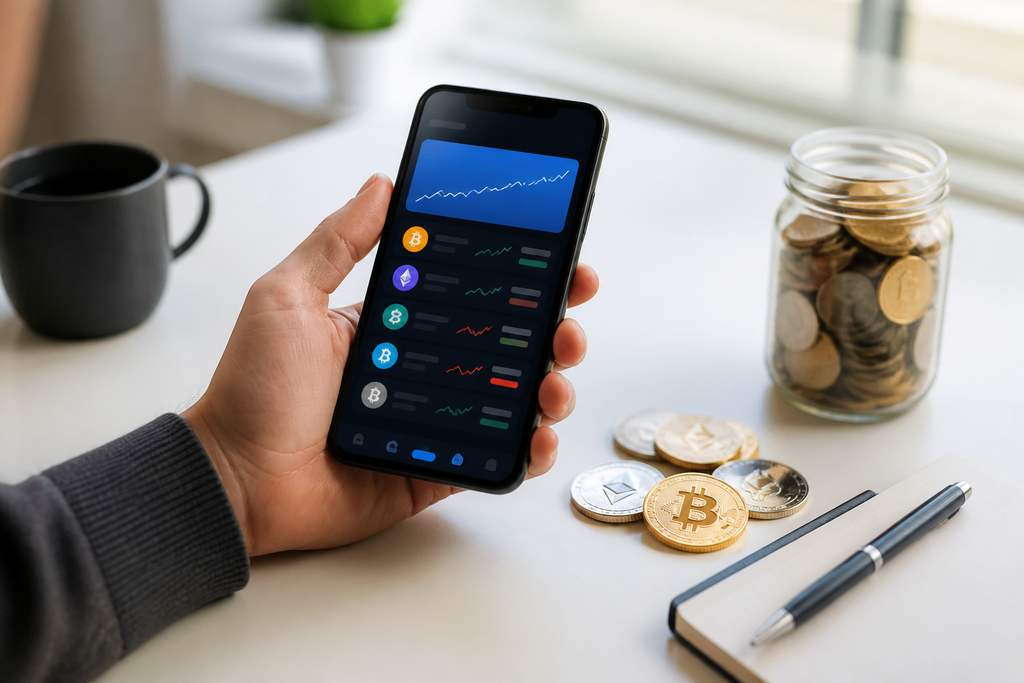
B2F is one of those strings that reaches a crypto search box without carrying a settled definition. Unlike DeFi or stablecoin, it has no industry-wide meaning: the same three letters surface as a token ticker on small listings, as business-model shorthand borrowed from B2B and B2C naming, and as an abbreviation inside individual platform brands. Which of these applies changes what a sensible next step looks like.
That ambiguity matters most when money is involved. A reader considering a B2F-branded purchase is really facing three separate decisions: which meaning is in play, which venue can actually deliver the asset, and which custody arrangement fits the intended holding period. This article compares the main options on each of those points, using mechanisms that can be verified rather than names that have to be trusted.
A plain-language answer to what is b2f crypto
The label appears in three distinct contexts. The first is a token ticker. Tickers on small-cap listings are not unique identifiers — several unrelated tokens on different chains can trade under the same three or four letters at the same time — so B2F on one decentralized exchange and B2F on another may point to two different contracts with different supplies, different holders, and different levels of liquidity.
The second context is a business-model tag. In fintech outside crypto, B2F generally reads as business-to-farmer: companies selling inputs, equipment financing, or advisory services directly to farms rather than through intermediaries. Blockchain projects in agriculture and supply-chain finance have adopted the same tag, and marketing material occasionally stretches it to business-to-fan for creator-economy platforms. The third context is the simplest: B2F as part of a brand name, where it stands for whatever that company says it stands for.
None of these readings is standardized, which has a direct consequence: a definition copied from a single webpage — especially one that also offers a purchase button — is a weak basis for a decision. Identification has to run through a contract address, and the sections below compare the options for verifying one, buying the asset, and storing it.
How the business-to-farmer model ends up on-chain
Where B2F carries its business-model meaning, the crypto component usually sits in one of a few places. Supply-chain projects tokenize records of produce moving from farms to buyers, so provenance claims can be checked against an immutable ledger. Financing projects convert receivables — a cooperative’s claim on a buyer, or a farmer’s input credit — into tradeable instruments. Payment projects build settlement rails so money moves between agribusinesses and farm suppliers without several intermediary banks in the middle.
The diligence question for this category is concrete: who is the real-world counterparty? A token with a farming narrative but no identifiable cooperative, warehouse, processor, or lender attached to it is a story rather than a business, and agriculture has historically attracted its share of schemes precisely because the underlying assets are hard for outsiders to inspect. Projects that name their counterparties, publish audited contracts, and register in jurisdictions with functioning courts give at least something to check. Projects that offer none of that give nothing.
The main options for buying and holding a B2F token
Assuming a specific B2F token has been identified, the venue question sorts into three realistic routes. A centralized exchange listing offers the easiest entry — fiat deposits and familiar order types — but the tokens sit in custodial control until withdrawn, and many small tokens are simply not listed anywhere. A decentralized exchange paired with a software wallet works for tokens no exchange lists, because anything with a deployed contract and a liquidity pool is tradeable; the costs are network fees and exposure to malicious contracts. A hardware wallet is not a buying venue at all but the storage layer on top of either route, keeping the keys offline.
The table below lines up the three routes against custody, suitability, and cost, so the comparison can be read at a glance.
| Option | Custody model | Best suited for | Main trade-off |
|---|---|---|---|
| Centralized exchange | Platform holds the keys | Fiat deposits and simple order types | Token may not be listed anywhere |
| Decentralized exchange plus software wallet | User holds the keys throughout | Tokens no exchange lists | Network fees and malicious contracts |
| Hardware wallet | Keys kept offline by the user | Long-term storage after any purchase | Device cost and slower trading |
The table leaves out a fourth option deliberately: waiting. Unlike a capped presale, a token that trades today will still trade next week, and urgency manufactured through countdown timers or bonus windows is itself a signal worth weighing. If the identification steps below cannot be completed, declining to buy is the option with the best risk profile.
Verification checks that cost nothing
Every check here can be run free, before any funds move. Start from the ticker: search it on a major data aggregator and note whether a listing exists at all. If one does, the listing page is the reliable source of the contract address; a token’s own website is a weaker source, because lookalike projects can copy a design overnight. Paste the address into the explorer for the relevant chain and read three things: whether the token’s name and supply match the listing, whether the liquidity pool has depth and a lock, and how concentrated the holdings are among the top wallets.
Chain identity matters as much as the contract itself. The same ticker can exist on several networks at once, with only one instance connected to the project in question and the rest either abandoned or created to capture search traffic. Buying the wrong string of letters is one of the more common ways to lose funds on a small-cap purchase, and it is entirely preventable at the explorer stage.
Definitions this thin are exactly what a reference library is for. The crypto FAQ category on this site collects answers to questions like what is b2f crypto in one place, which makes it a faster cross-check than the promotional page that introduced the term in the first place. One red flag deserves its own sentence regardless of source: no legitimate airdrop, migration, or verification step requires a seed phrase, and any page that asks for one has announced its purpose.
A concrete routine to run before any money moves
Assemble the checks into a fixed order and run them the same way every time. First, search the ticker on a major aggregator; if no listing appears, treat every site promoting the token as unverified. Second, take the contract address from the listing page and confirm it on the explorer of the stated chain, checking name, supply, liquidity lock, and holder concentration. Third, choose the venue from the comparison above — a centralized exchange when the token is genuinely listed, a decentralized exchange with a software wallet when it is not — and move the purchase to a hardware wallet if the intention is to hold rather than trade. Fourth, size the position so that a total loss is an annoyance rather than a problem.
The stop rule matters more than any individual step: if a contract address cannot be confirmed on at least two independent sources — a listing page and an explorer, or an explorer plus a project announcement that itself links the explorer — the honest answer to a B2F-branded offer is no purchase at all, at any size. A ticker that cannot be identified is an unanswered question wearing a ticker symbol, and unanswered questions make poor investments.