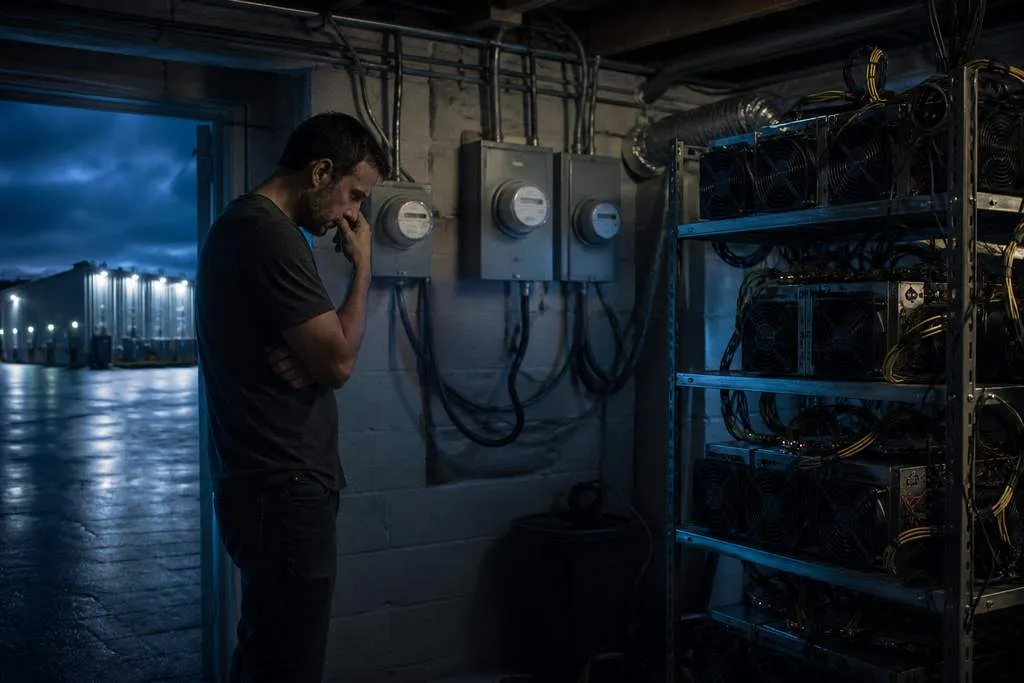
Every mining question eventually collides with the same mechanism: proof-of-work networks that are easy to mine do not stay profitable, and networks that stay profitable do not stay easy. Difficulty adjustments run automatically on essentially every such chain, steering new hashrate toward thinner per-machine rewards until the marginal miner earns little more than its electricity cost. A coin that looked effortless last quarter has usually attracted enough machines this quarter to erase the gap.
That built-in arbitrage is why a single coin name is the wrong answer. Profit is the gap between the revenue a unit of hashrate produces and what that unit costs to run — electricity first, then hardware wear and pool fees. The useful question is which network matches hardware you already own, or can buy, at an electricity rate the reward stream still justifies. The sections below trace the machinery that decides that gap, then apply it to the realistic options.
Difficulty adjustment is the mechanism that levels every field
Bitcoin retargets its difficulty every 2016 blocks, roughly two weeks, so that blocks keep arriving on a ten-minute schedule no matter how many machines join or leave. Double the network hashrate and the next adjustment doubles the difficulty, cutting every individual machine’s expected revenue in half. Monero works the same way on a shorter cycle, so its difficulty tracks its hashrate far more tightly. The invariant behind both: a chain issues roughly the same number of coins per day whether one miner or a million are running, so each participant’s income equals their share of total hashrate, not the network’s output.
This also explains the boom-and-bust rhythm of small coins. When a GPU-minable network pays unusually well, hashrate migrates in within days, difficulty climbs, and revenue per card settles back toward operating cost. Ethereum’s move to proof of stake in 2022 removed the largest GPU-mining market overnight and scattered that hashrate across smaller chains, making the remaining niches more crowded and faster to close. The profitable window exists, but it closes by the very act of being exploited.
The profit formula has four terms and electricity dominates
Daily revenue reduces to a short expression: your hashrate divided by the network’s, multiplied by coins issued per day, multiplied by the coin’s price. Industry shorthand compresses the first two parts into “hashprice” — the dollar revenue one unit of hashrate earns per day — which mining pools and calculators publish for each algorithm.
Costs divide into running costs and capital costs. Running costs are watts drawn multiplied by hours multiplied by your per-kilowatt-hour rate, plus the pool’s fee, commonly around one percent, plus cooling in warm climates. Capital cost is the machine itself, amortized over the years it stays competitive.
The electricity term explains most real-world outcomes. An older ASIC that consumes twice the power per unit of hashrate earns the same revenue as a current-generation machine yet pays double the energy bill, so when margins compress it goes dark first while efficient hardware keeps running. The same coin can simultaneously be profitable for one miner and a loss for another.
What Is the Easiest and Most Profitable Crypto to Mine, by Hardware Class
Given that frame, the practical answer breaks down by hardware class. Monero’s RandomX algorithm was built to run on ordinary CPUs and to blunt the efficiency advantage of specialized chips, which makes it the default for anyone whose only asset is a computer. GPUs remain the tool of choice for networks with memory-hard or graphics-friendly algorithms such as Ergo’s Autolykos and Ravencoin’s KAWPOW, where the design goal is delaying, though rarely preventing, ASIC arrival. Owners of purpose-built Scrypt machines usually point them at Litecoin while merged mining Dogecoin on the same work through Auxiliary Proof of Work, collecting both rewards from one machine. And SHA-256 machines, the Bitcoin class, face the deepest competition in existence: their economics are essentially an electricity-rate contest.
One question survives every rotation — what is the easiest and most profitable crypto to mine — and the honest treatment of it is a set of mechanics rather than a ranked list. Hashrate migrates to whatever pays best this week, difficulty follows, and the ranking reshuffles within weeks, which is why our crypto FAQ archive keeps the underlying mechanics, from difficulty behavior to payout rules, in one place that does not go stale.
How the Four Hardware Routes Compare
The table condenses the trade-offs into one view: accessibility and competition move in opposite directions, and hardware that is cheap to acquire is, by definition, hardware everyone can acquire.
| Hardware class | Typical networks | Entry barrier | Where the margin usually goes |
|---|---|---|---|
| CPU (RandomX) | Monero | Lowest — a desktop works | High power draw of general-purpose chips |
| Consumer GPU | Ergo, Ravencoin | Moderate — gaming cards resell easily | Rotating niches and card resale value |
| Scrypt ASIC | Litecoin with Dogecoin merged mining | High — purpose-built machines | Machine efficiency and pool fees |
| SHA-256 ASIC | Bitcoin | Highest — industrial scale | The electricity rate, above all |
One asymmetry in the table deserves extra weight: a gaming GPU bought for mining carries a second-hand market of players, while an ASIC’s resale value tracks the economics of the single coin it was built to mine.
The Costs That Never Appear in Calculator Defaults
Calculators model hashrate, power, and price. They rarely model the rest. Machines age: fans fail, thermal cycling degrades boards, and dust in an unventilated corner raises operating temperature and power draw. Heat and noise impose real constraints in apartments and shared buildings. Resale value differs sharply by class, as the table above showed. Payout mechanics matter too: pools set minimum withdrawal thresholds and pass on network fees, which weigh on small setups more than large ones. Tax treatment is a further line — in many jurisdictions, including the United States, mined coins count as taxable income at their fair value when received, with capital gains rules applying again on disposal. A margin that survives electricity but not tax is no margin.
Solo Mining Versus Pools: Identical Expectation, Different Variance
Joining a pool changes the distribution of income, not its average. Pooled mining pays small, frequent amounts proportional to contributed work, minus a fee; solo mining pays the full block reward but only when your machine actually finds one — at home-scale hashrate against Bitcoin’s total, an event most setups will never see. The expected value of the two approaches is the same; the variance is not. Pay-per-share schemes push that variance onto the pool operator in exchange for a slightly higher fee, which is why small miners overwhelmingly take them. At home scale, variance alone decides whether income arrives at all.
A Decision Procedure That Beats Guessing a Coin Name
The takeaway is a procedure, run monthly because difficulty and price both move. Read the all-in electricity rate off a utility bill, including taxes and delivery charges expressed per kilowatt-hour. Benchmark the hardware — hashrate and wall-draw watts for each candidate algorithm, measured rather than copied from spec sheets. Feed both into a mining calculator for two or three candidate networks and read the daily net. Then compare against the alternative: the same hardware budget spent directly on the coin. Mining ties capital to a depreciating machine that must out-earn a volatile asset over years; if the payback period runs past the machine’s realistic competitive life, or the net margin sits within a rounding error of zero, buying the coin — or doing nothing — is the honest answer. Marginal cases can tip the other way when waste heat replaces winter heating, and that is the one place where home mining genuinely beats the arithmetic.